- FY 2012-13 annual report not available on www.bseindia.com despite AGM notice being filed. I had to download it from http://www.vikaswspltd.in/annual-reports/2012-13.pdf and even this is NOT a complete annual report-it just has auditor's report and financial statements! An elementary omission(or maybe not?)
- Auditor remuneration dropped 40% y-o-y without a reduction in activities/scale. Commendable if this is cost cutting, but then what does it hold for audit quality? Incidently, the old firm a Big4 auditor BSR & Co(an Indian member of KPMG) was dropped from 2011-12 onwards, after its emphasis of matter in the audit report.

- Inconsistent information. For example. domestic sales of Rs 730 Crs as disclosed in segment disclosure< domestic sales of Rs 558 Crs as disclosed in revenue note.


- Working Capital position seems precarious with advance to suppliers increasing 25x from Rs 25crores to Rs 563 Crs. While this is backed by customer advances(Rs 170crs in Fy13 vs Rs 120crs in FY12), this is not an encouraging sign.
- Lolmax corporate governance/basic lack of knowledge of secretarial procedures:- While appointing a relative as a director, the explanation was Ms. Kamini Jindal has been appointed by the Board as an Additional Director w.e.f. 16.07.2012. Ms. Kamini Jindal is a person with excellent academic background and possesses good educational qualifications. She is
Bachelor of Arts and Master of Philosophy. She is the youngest in the Board of the company. Considering and seeking attention and interest of youth, your Directors recommend appointment of Ms. Kamini Jindal as Director of the Company(emphasis added). For god's sake, why pretend to empower youth? And why omit the (obvious) fact of other family directors being interested in the matter? - Punter driven stock: For example http://mmb.moneycontrol.com/stock-message-forum/vikaswsp/comments/1501
- Possible value trap-low Pitrovski score http://www.equitymaster.com/detail.asp?date=06/12/2013&story=1&title=A-sure-shot-method-of-avoiding-value-traps
- Probable short term loss due to purchase commitments:- Vikas WSP currently has 60,000 tonnes of guar polymer production capacity which is running full. An additional 30,000 tonnes of capacity is expected to commence commercial production by the end of the current financial year. For 100% capacity utilization, the company requires 70 lakh bags of guar seed which has already been insured. Probably this is what the supplier advance is towards Against the assured price of Rs 50 a kg, guar seed price has now fallen below Rs 42 a kg http://smartinvestor.in/common/srchoutdet-190588-car-Guar_seed_price_fall_pushes_Vikas_WSP_in_tight_spot.html
Showing posts with label Value Investing. Show all posts
Showing posts with label Value Investing. Show all posts
Tuesday, September 3, 2013
Vikas WSP-why it deserves its P/E multiple of 1 despite great results
Whenever shale gas discoveries are announced in USA/EU, guar gum prices shoot up(since it is used as a fracking material in shale gas extraction), and then Vikas WSP gets into the news. Punters shoot up the stock price hoping to benefit from the hike in realizations, or from the appreciating rupee, considering that most of the company's sales are from exports. However, those who forget the past are bound to commit mistakes in the future, nowhere is this more relevant than Vikas WSP. Let us see the (in)glorious highlights of this company


Saturday, June 1, 2013
RBI disclaims regulation of non banking financial sector(NBFC) LLPs
In an earlier blog post in Jan-13, I'd written http://financeandcapitalmarkets.blogspot.in/2013/01/warren-buffets-investment-partnerships.html that RBI regulations apply to NBFCs(non banking financial COMPANIES) and not to firms, why should the LLP be subject to this? Section 14 of the LLP Act 2008 states that On registration, a limited liability partnership shall, by its name, be capable of.....(d) doing and suffering such other acts and things as bodies corporate may lawfully do and suffer. Section 2(d) of the LLP Act2008 defines body corporate.... “body corporate” means a company as defined in section 3 of the Companies Act, 1956 (1 of 1956) and includes..Therefore,
since LLP is a body corporate under the Act and subject to other acts
applicable to body corporates, the RBI NBFC norms will apply to it to
the same extent that they would apply to companies.
However, in its circular yesterday, the RBI expressed the view that
rbi.org.in/scripts/FAQView.aspx?Id=92 LLPs are regulated by the Ministry of Corporate Affairs and not by it. Is this a case of regulatory arbitrage, given that LLPs are explicitly an alternate to private sector companies? And more importantly, will the Registrar of Companies dispense with RBI approval for LLPs on the basis of this circular? only time will tell.
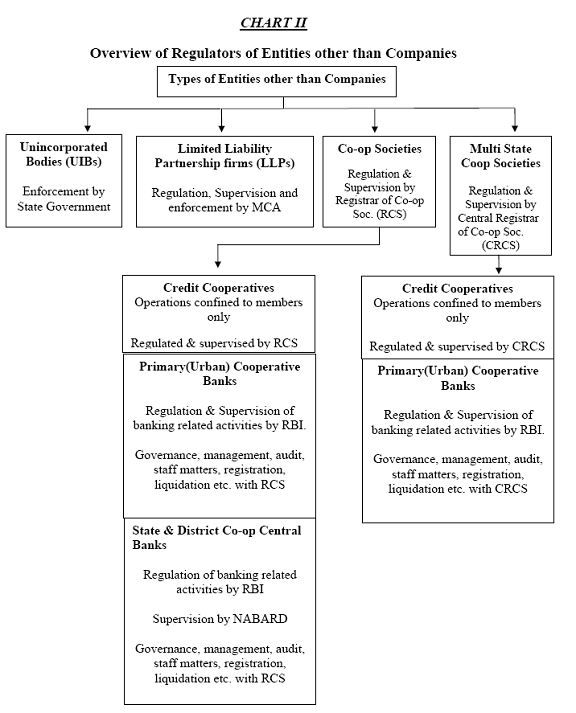
However, in its circular yesterday, the RBI expressed the view that
rbi.org.in/scripts/FAQView.aspx?Id=92 LLPs are regulated by the Ministry of Corporate Affairs and not by it. Is this a case of regulatory arbitrage, given that LLPs are explicitly an alternate to private sector companies? And more importantly, will the Registrar of Companies dispense with RBI approval for LLPs on the basis of this circular? only time will tell.
Tuesday, January 8, 2013
Warren Buffet's investment partnerships cannot be born in India as LLP even now
Warren Buffet built his initial reputation and winnings through an investment partnership, where friends/relatives/acquaintances invested their capital in partnership with his acumen! It was a win-win for both parties in the end. However, in India, thanks to the legal and regulatory issues, this is next to impossible. Recently, a friend was thinking of setting up his own investment partnership in which he wanted auditable returns, favourable tax treatment, ease of entry/exit of investors, and least administrative cost. But after reading this excellent article http://capitalmind.in/2011/06/creating-a-hedge-fund-in-india/ I realized that that would be next to impossible. Since that article did not cover LLPs in depth, I decided to do so. This would cover questions like structuring investment partnership as LLP etc
- What do I mean by investment partnership? As commonly understood, investment partnership happens where investor funds are pooled in a common strategy, without any investor specific customization within the fund. For example, 10 friends entrust Rs 5 lakhs each to their common friend Mr X to invest in special situations. This would be an investment partnership, as funds are pooled.
- Which regulations govern this? The securities regulator SEBI governs portfolio managers(discretionary and otherwise), mandating minimum investment limit(Rs 25 lakhs), restrictions on fee methodology(water mark etc). Even for those who feel they are not covered by that restriction due to 'not being companies etc', the SEBI Alternate Investment Regulations 2012 cover this ―Alternative Investment Fund‖ means any fund established or incorporated in India in the form of a trust or a company or a limited liability partnership or a body corporate which,-(i) is a privately pooled investment vehicle which collects funds from investors, whether Indian or foreign, for investing it in accordance with a defined investment policy for the benefit of its investors; and (ii) is not covered under the Securities and Exchange Board of India (Mutual Funds) Regulations, 1996, Securities and Exchange Board of India (Collective Investment Schemes) Regulations, 1999 or any other regulations of the Board to regulate fund management activities: Since the partnership will be an investments company by its very nature(http://india-financing.com/Question_of_Definition-What_Exactly_is_an_NBFC.pdf), RBI regulations of registration etc will apply http://www.rbi.org.in/scripts/FAQView.aspx?Id=71
- RBI regulations apply to NBFCs(non banking financial COMPANIES) and not to firms, why should the LLP be subject to this? Section 14 of the LLP Act 2008 states that On registration, a limited liability partnership shall, by its name, be capable of.....(d) doing and suffering such other acts and things as bodies corporate may lawfully do and suffer. Section 2(d) of the LLP Act2008 defines body corporate.... “body corporate” means a company as defined in section 3 of the Companies Act, 1956 (1 of 1956) and includes..Therefore, since LLP is a body corporate under the Act and subject to other acts applicable to body corporates, the RBI NBFC norms will apply to it to the same extent that they would apply to companies.
- Are any minimum qualifications needed? After reading the SEBI AIF Regulations at the link below, I realized that this would be a difficult http://www.sebi.gov.in/cms/sebi_data/attachdocs/1337601524196.pdf the key investment team of the Manager of Alternative Investment Fund has adequate experience, with at least one key personnel having not less than five years experience in advising or managing pools of capital or in fund or asset or wealth or portfolio management or in the business of buying, selling and dealing of securities or other financial assets and has relevant professional qualification;
- The requirement of three regulators? Renowned lawyer Mr Sandeep Parekh opines that both RBI and SEBI will need to give approval, apart from the administrative approval from Companies/LLP regulator. "It's a three-stage process for RBI-regulated entities like non-banking finance companies (NBFCs). The first step would be to incorporate; this is done by the Registrar of Companies. Second, they have to obtain a licence to operate as NBFC and for which it must apply to RBI; and thirdly, if an NBFC intends to provide investment advisory services it will likely need permission first from RBI and then from Sebi," said Sandeep Parekh, founder of Finsec Law Advisors. "This would obviate turf wars between financial regulators," he said. http://articles.economictimes.indiatimes.com/2012-10-02/news/34218105_1_sebi-board-capital-market-regulator-corporates In practice, some friends inform me that the LLP/companies registrars seek NOC from RBI even before first step!
Conclusion:-Given the capital, annual fees and experience requirements, such a venture would be stillborn in India if intended to be run legally.
Thursday, March 15, 2012
Why older people should make better value investors
During the Behavioural Finance elective taught by Prof Joshy Jacob at IIM Ahmedabad, some points were quite interesting, and after connecting the dots, I thought of this post. We see very few old traders, but we see umpteen value investors over 50(Buffet/Munger as the most famous examples). Like vintage wines, they seem to grow better with age. Some possible reasons for this are below(for this post I mean value investors as those who trade based on perceptions of value, and not on technical indicators solely!).
- Knowledge-As we age, the accumulated knowledge and wisdom is expected to grow, helping spot more connections, and more importantly, realizing that the 'new thing on the block' is just a revamped version of the past
- Self Discipline-This does grow with age, and is important for decisions like SIPs, cutting loss etc
- First hand experience of market cycles-This helps investors to avoid getting caught up in booms/panics because they have seen it all before, and hopefully should be able to remember the past.
- Lower testosterone:- As the testosterone levels go down, the tendency for noise trading would go down, and patience is more. That would help for value investors.
Subscribe to:
Posts (Atom)